
Why Boundless?
A few notes on why I'm writing a book - and the contours of land policy in Australia.

Well the cat’s out of the bag and I’m happy to announce that Jonathan O’Brien (long-time valued friend, interlocutor and comrade-in-submission-writing down at YIMBY Melbourne) and have partnered with the excellent team at Pantera Press/Hardie Grant to deliver Boundless to a bookstore near you by mid 2027.
What is “Boundless?” Good question, and I don’t yet entirely know. The nature of books is they tend to grow and evolve in the writing, and so I’m loath to describe it too closely here (and of course I want you to actually go out and read the thing when it hits the shelves).
But I can, in broad strokes, tell you about the question it seeks to answer, and then, a little bit about why I thought that attempting to answer it myself could be a socially valuable endeavour.
Boundless will be a book about land and what we permit to be done with it. It is a book about what I’ve sometimes called spatial regulation, about the rules that we as a society impose on what can be done on the physical world. We don’t think of our physical reality as the product of law, of political decisions, but it is. The shape of our cities, and consequently the minutes of our lives is shaped by the software of obscure codes, regulations, standards and plans as much as these pixels on your screen are determined by computer code.
We’re far from the first to throw our hats in the ring. Popular discourse has been overwhelmed by an avalanche of works seeking to address this question. Nolan Gray’s Arbitrary Lines, Dan Wang’s Breakneck, Jerusalem Demsas’s On the Housing Crisis, Marc Dunkelman’s Why Nothing Works, and of course, Ezra Klein and Derek Thompson’s Abundance. What more could we possibly add?
When I started this journey back in 2021 with the rest of the team at Greater Canberra, I thought that positive reform was mostly a question of economics, of being able to demonstrate empirically the value of reform. That if we walked into offices and community meetings armed with the mountains of academic research that proved that residential zoning reform could enable lower housing costs and increased quality of life, we’d be get reform over the line.
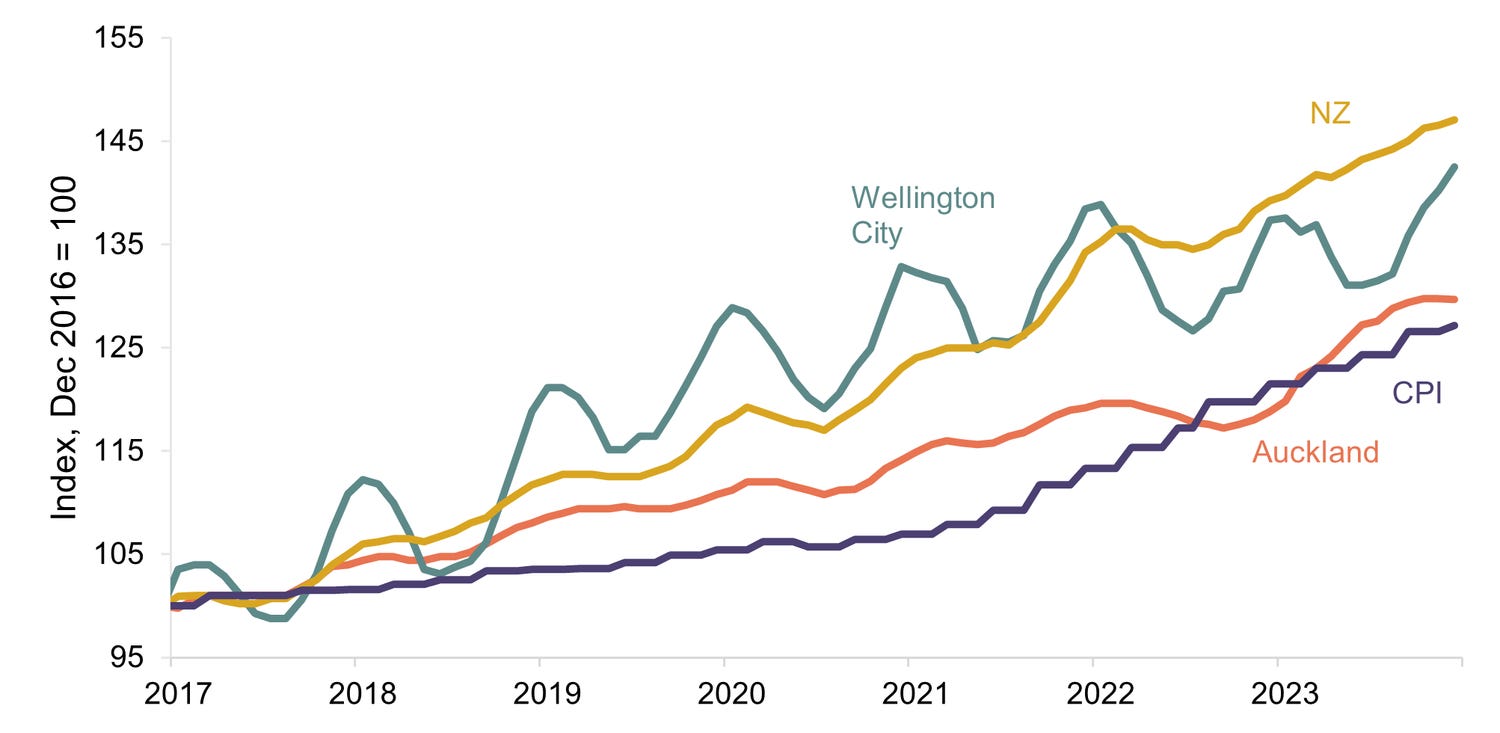
And the applicability of that empirical evidence is generally universal. Housing markets don’t work so differently in Auckland than they do in New Zealand that makes the empirical evidence irrelevant. If getting reform done was as easy as presenting a few lines on a chart, then it would happen instantly everywhere.
But then almost immediately you realise that the crucial questions of “why are things the way they are?” and “how can fix them?” are entirely driven by questions of local context. History, institutions, legalisation, culture, politics, constitutional structure. How decisions are made, and by who? Where does power lie?
And even though the economic literature on, say, the impact of zoning liberalisation on housing affordability might be universal, the context in which a given jurisdiction’s rules about where and how housing can be built will be unique to itself.
So many of the rules that govern our lives are globalised, standardised. A phone charger in the EU will work in Argentina. A car that is street legal in one country likely will be street legal in many others. Digital and physical goods move across national boundaries largely seamlessly.
Meanwhile spatial regulation is hyper localised. Buildings and infrastructure do not move. A house built today would not be legal to build in another part of the same city, let alone in a different city or on the other side of the country. That same house would not be legal to build in 20 years time.
And the process of meaningful reform is, practically, engaging with that local context to change rules, institutions and processes to change outcomes. It is about politics. It is about intensely local, weird, unique politics. It is about steering the ship of state to a new destination.
And we can see this clearly in the current literature on the topic, which place these questions front and centre. The problem is they are American authors, writing to an American audience, about the American context. Abundance famously became the hottest book inside the Parliamentary Triangle for a period last year, and its ideas have been highly influential within the corridors of Australian power.
American vs Australian Governance
And for the most part this isn’t a bad thing. Australia and the United States share a common cultural, political and constitutional heritage. Our “Washminster” constitutional system draws equal inspiration from both the United State’s written constitution and the United Kingdom’s unwritten one. When Australian governments consider ideas for reform, their eyes inevitably look across the Pacific, and much of our modern systems of spatial regulation, particularly our systems of environmental protection and judicial and merits review of administrative decisions have taken inspiration from the American example.
But Australia is not the United States. Our cultural expectations about the role and duties of the state in Australian life are different, as are its corresponding relationship with the people and land of Australia. Our institutions are structured differently, postured towards different ends, and consequently with different strengths and weaknesses.
Much of this is good news. All American literature ends up circling the twin problems of American governance:
That American legislative power is broadly dysfunctional at national and subnational levels, as constitutional, procedural and institutional veto points make legislative reform extremely difficult.
That even when the US does eventually make a legislative decision, it is so vulnerable to judicial challenge that intent of the legislation is rarely ever promptly or accurately realised – and that furthermore these process vulnerabilities critically weaken the state capacity of American governments.
The Commonwealth of Australia and the several states suffer no such infirmities. Throughout post-colonial Australian history, the state has always been expected and empowered to play a central role in Australian life. It was a pattern that begun with the autocratic governors prior to self government, but one that has continued since.
In 1930, Keith Hancock observed that “Australians have come to look upon the state as a vast public utility, whose duty it is to provide the greatest happiness for the greatest number”. The Australian state provides healthcare, education, transport, infrastructure, regulates working conditions and wages, facilitates development, provides pensions and mandates retirement savings, safeguards the natural environment - and the political authority of the state to do these things is unquestionable.
To enable the Australian state to perform this role, Australian Parliaments are simply much more powerful than their American counterparts, without the restraints that the framers of the United States constitution sought to apply to excercises of state power. Owen Dixson, Chief Justice of the High Court once attempted to explain this to an American audience in this way:
Why, asked the Australian democrats [and authors of the Constitution], should doubt be thrown on the wisdom and safety of entrusting to the chosen representatives of the people sitting either in the Federal Parliament or in the State Parliaments all legislative power, substantially without fetter or restrictions?1
Particularly during moments of crisis, the Australian state moves with a level of speed and decisiveness that few others are able to match. Australia’s response to the COVID-19 pandemic remains controversial, but its a powerful demonstration of the peerless power of the Australian state to mobilise society and marshal social resources towards a common goal.
Where Americans sought to use law to restrain government through the Bill of Rights and other constitutional protections, the Australian approach has always been one that seeks protection through participation and representation in political and state institutions. Universal suffrage, the secret ballot, salaries for parliamentarians, the union movement, the decision of that union movement to pursue their goals via contesting elections rather than revolution - all of these are examples of this trend.
There has been strong, continuous, benevolent government in Australia but no ruling class. When the governors ruled, the rich landowners and squatters thought they would take over when self-government was granted. But when that happened, they were quickly defeated and democratic politics began. The democratic politicians were a very mixed bag indeed, not identified with any one group in society, so distinct that they were a group in themselves—the despised politicians, which is how they have remained.
Government is without social character; it is an impersonal force. That makes it possible for Australian egalitarians to give it the great respect which its record deserves. Australians are suspicious of persons in authority, but towards impersonal authority they are very obedient.2
Differences in practice: Canberra vs Washington DC
What does this mean practically for issues like zoning codes, transport infrastructure codes and other forms of spatial regulation? It means that the Parliaments can just do things.
Canberra and Washington DC are similar cities in many ways. Besides from all the obvious commonalities, at a metropolitan level:3
Both cities are currently building a Light Rail network - Canberra Light Rail and Maryland’s Purple Line.
Both cities have/are reforming their suburban zoning codes, through the Missing Middle Housing Reforms in Canberra, and Missing Middle Arlington in northern Virginia.
How this has worked out practically however demonstrates the considerable gap between Australian and American governance.
A story of two light rail lines
In both cases, DC went first. The Purple Line has existed as a concept since the 1980s, and the project has been substantively underway since the 2000s. It is currently slated to (maybe) open in 2027. The project has become infamous as an example of both of the failures of American governance in spatial regulation cited above - it took decades for the project to get underway, and once underway it was stuck in litigation purgatory for decades more. Jerusalem Demsas described it in this way:
So I grew up in Montgomery County Maryland, which is one of the Maryland counties that borders Washington, D.C. And the Purple Line is an above ground light rail project that has been trying to be built since before I was even born. And for 20 years — from when I moved there to now — the project is still not completed. And costs have risen just astronomically in completing the project. And the ones that are really causing a lot of the delay are these wealthy homeowners in Chevy Chase, Maryland, which is a very wealthy suburb of the District of Columbia.
So you have these folks who, essentially, have been suing to stop the transit line from coming through. And they’ve offered a bunch of different justifications for this. One was that there is some endangered species that might be harmed by this. It took a lot of litigation and time to discover that they could not find it or any evidence of it at all. And they delayed it for a serious amount of time because of that. And then, you had in addition to that complaint, they offered up a bunch of other ones about how ridership was going to be low, and how people had ridden the bus along the way that the rail line would be built. And that there wasn’t that much ridership.
Ignoring the fact that, of course, if you built a rail line people would be able to use that and be much more efficient than the current several different buses you’d have to take to get along the exact same route. And so, at this point, it’s taken over two decades. I thought that I was going to ride the Purple Line when I was in high school. And that never happened. And people are really mad. And there’s even people who are infamous, at this point, in the broader Maryland political community for having been one of two major proponents of the lawsuit.
The Purple Line is currently estimated to cost somewhere between $3.4-4 billion USD to build, somewhere between $132-155 million USD a km. Construction has been underway since 2017 (interspaced with three lawsuits and a change in contractor), and will now take over 10 years.
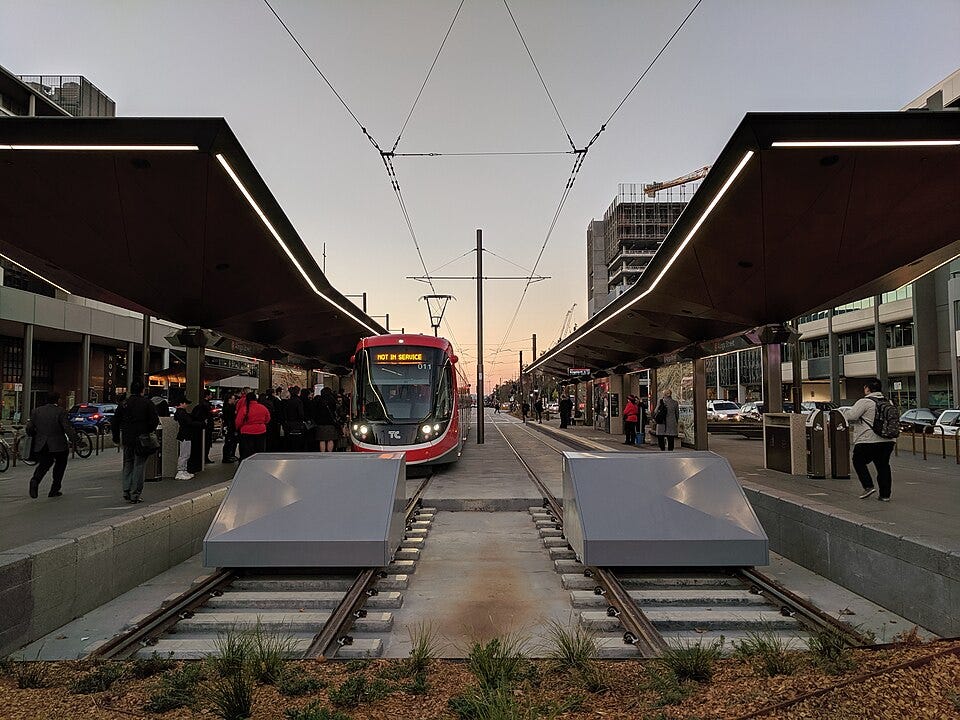
When the Purple Line was first mooted in the 1980s, the Canberra district of Gunghalin was still a collection of paddocks slated for future urban development. The idea of constructing Light Rail in Canberra - including along the eventual Stage 1 route - had been discussed for decades. However, it only entered formal government policy in 2012, when construction of what is now Stage 1 of the Light Rail became a term of the Governing Agreement between ACT Labor and the ACT Greens following the October 2012 election. What followed, was, compared to the Purple Line, almost comically rapid:
Funding for initial design work was provided in the 2013/14 budget, and a new Government agency - the Capital Metro Agency was established for project delivery.
The business case for the project was approved in September 2014.
In March 2015, the project moved to a formal request for proposal from two competing consortia.
In May 2016, the contracts for the delivery of the project was finalised.
In July 2016, construction of the line began.
Construction was completed by June 2018.
The line opened for services on 20 April 2019.
Stage 1 of the Light Rail cost $675 million AUD to build for a line length of 12km - ~$58.9M AUD per km. Construction took two years and 9 months, the time between making the decision to build the line and the line opening was six and a half years. To clear the way for Light Rail, the ACT government legislated exceptions to usual rights to challenge development applications.
In previous infrastructure projects, the ACT Legislative Assembly has moved to extinguish rights to judicial challenge to infrastructure projects, as it did with the Gungahlin Drive Extension Authorisation Act 2004.
Of course, these two projects are not perfectly comparable to one another. The Purple Line is more than twice as long, and substantially more technically complex. None the less the key differences between the projects in terms of cost and speed was not driven by engineering complexity, but by the differences in Australian and American governance.
Neither is this an isolated case. The United States hasn’t built anything comparable to Sydney Metro this century. It’s not alone - Metro Tunnel in Melbourne, Crossrail in Brisbane, Light Rail Stage 2A in Canberra, Metronet in Perth - throughout the Commonwealth, Australians governments are simply much better at building public transport infrastructure (and transportation infrastructure generally) than American ones.
A tale of two zoning reform proposals
Simultaneously, both Arlington, Virginia, and the Australian Capital territory are currently pursuing reforms of their single family zoning codes.
The pathway to what has become Arlington County’s Expanded Housing Options (EHO) Ordinance, began in the mid 2010s. After around half a decade of community campaigning and public consultation, the County officially launched the Missing Middle Housing Study in 2020. After three years of public debate, the Arlington County Board approves the EHO ordinance in early 2023.
But this is America, and so in April 2023 the ordinance is challenged in the Virginian court system. In June 2024, a circuit court judge strikes down the ordinance, and by November the County Board votes to appeal. In June 2025, the Court of Appeal overturned the circuit court decision, temporarily restoring the EHO, but then the next month they withdraw their own decision, before confirming the overturn of the Circuit Court decision in September 2025. The plaintiffs in that case have now appealed to the Virginia Supreme Court.
It’s worth noting here that the Court of Appeals voided the lower court’s decision on a procedural error made by the lower court, and so even if the Virginia Supreme Court upholds the Court of Appeal’s decision, the practical consequence is booting it back down to the Circuit Court for reconsideration - effectively restarting the legal battle from square one, for it to potentially work its way back up through the court system again.
Even if Arlington County eventually “wins” the court battle and confirms its own power to reform residential zoning then, it will have done so at the cost of more than half a decade of delay. Perhaps curiously for what has turned into a multi-decade long process, the EHO ordinance is extremely modest. The maximum scale of any development is 6 units per residential blocks. The number of permits that can be issued per year is capped at 58.
Meanwhile what has become known as the Missing Middle Housing Reforms, or Draft Plan Amendment 4 (DPA-04) in the ACT has been far more rapid. When we formed the Missing Middle Canberra (MMC) coalition to campaign for it in February 2023, we looked to Arlington for inspiration. By July 2023, the ACT branch of the ALP incorporated it into its Policy Platform (I moved the motion). By September 2023, the ACT Greens did the same, giving the policy in principal support by a majority of the ACT Legislative Assembly.
Progress momentarily stalled, as the Government effectively decided against initiating the ACT’s largest ever reform of its residential zoning system in an election year. Both ACT Labor and the Greens campaigned on missing middle zoning reform in the October 2024 election, with Tom Emerson MLA committing to part of the platform.
The newly returned ALP Government then began the process of getting the procedural wheels rolling with alacrity, with DPA-04 and the associated Draft Missing Middle Design Guide released for public consultation in May 2025, with the revised version being referred to Legislative Assembly Inquiry in November 2025.
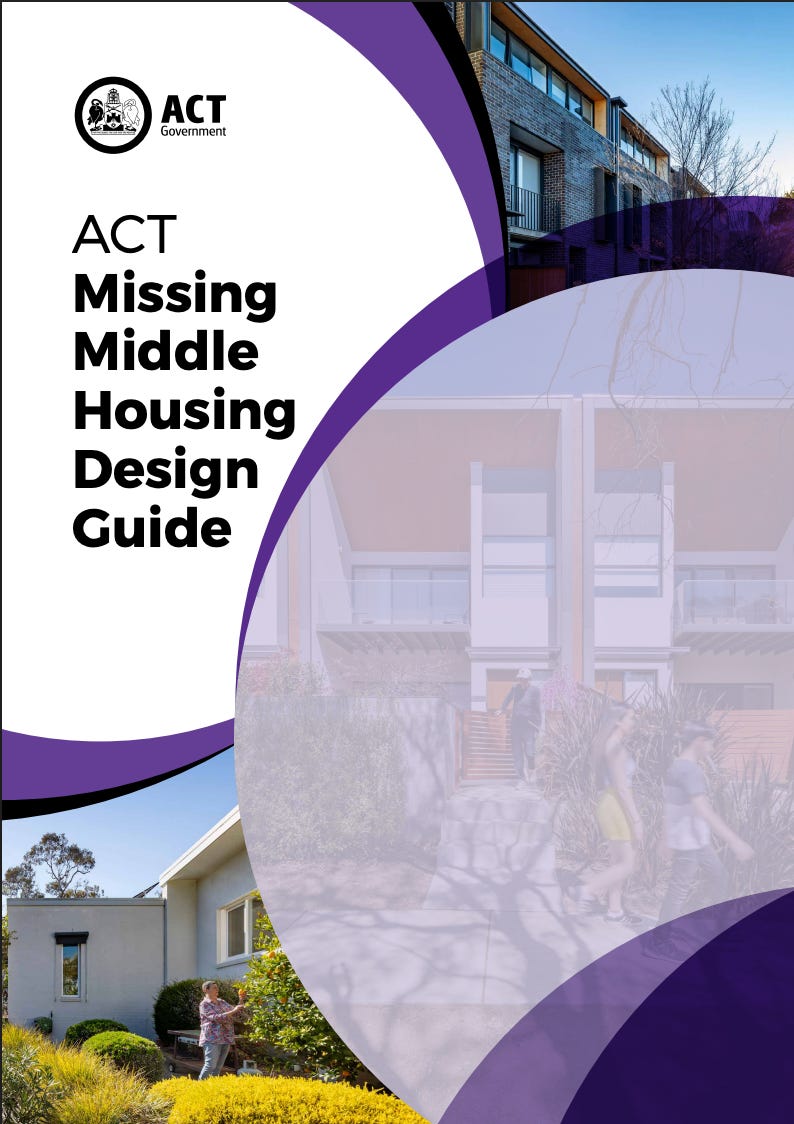
I attended the Legislative Assembly’s committee hearings on DPA-04 last month, and the reforms are likely to be implemented by September this year. If it dies, it will die in the legislature, not in the courts. Three and a half years from proposal to implementation of comprehensive zoning reform is, by American standards, incomprehensibly fast.
DPA-04 is a far more ambitious set of reforms than the EHO. If passed, it will apply to around ~110,000 ACT residential blocks, without Arlington’s paltry annual cap. It enables block consolidation to facilitate projects of dozens of units, rather than Arlington’s limit of a 6 unit multiplex.
Neither is the ACT alone. The Victorian and NSW state governments have also moved forward with ambitious and rapid zoning reform programs, overtaking much slower and more modest reforms in the US. Parliamentary sovereignty and the residual plenary power of state parliaments to legislate with respect to urban planning, combined with a political culture that has always recognised the legitimate role of state governments in urban matters have simply led to a much faster and more comprehensive legislative response.
Choices, not capacity
In 1958, Alan Davies in Australian Democracy opened his description of the Executive government thus:
The characteristic talent of Australians is not for improvisation, nor even for republican manners, it is for bureaucracy. We take a somewhat hesitant pride in this, since it runs counter not only to the archaic and cherished image of ourselves as an ungovernable, if not actually lawless, people; but, more importantly, because we have been trained in the modern period to see our politics in terms of a liberalism which accords to bureaucracy only a small and rather shady place. Being a good bureaucrat is, we feel, rather like being a good forger. But in practice our gift is exercised on a massive scale….
American literature asks “why nothing works”, and discusses the need to rebuild lost State capacity. But Australia has state capacity to spare. Time and time again - particularly in moments of crisis (GFC, COVID) - Australia demonstrates that we have no shortfall of capacity, no meaningful limit of our ability to quickly and decisively mobilise society and marshal resources to meet the moment, if we choose to.
But frequently, we don’t choose to. California has tried and failed to build a high speed rail line for almost a quarter of a century. Australia has considered building a high speed rail line for forty years. If we decided to build it, we would not fail as the Californians have. But instead, we have simply commissioned an endless series of studies, and never actually pulled the trigger.
Similarly, when we built Sydney Metro we choose not to upzone much of the suburban stations around Sydney’s north. We built one of the world’s best public transport systems (high speed, high frequency), and then ran it through single family home zoned suburbia. We always had the ability to, as the NSW government is now demonstrating through their belated Transit Oriented Development upzoning effort. Unlike what might have occurred in the United States, legal challenges to the State’s ability to do this are obviously doomed and have been quickly defeated.
In Australia then, our question is about choices, not capacity. We can do anything we decide to do. But we need to decide to actually do it. We can’t plausibly blame a shortfall in bureaucratic capacity (like the British can),4 or a dysfunctional political process for making decisions (like the Americans can). That truth is liberating, but it’s also damning. Because it means that our problems are the results of active choices we make.
Boundless then at its heart is going to be a story about those choices, and makes the case about how we could make better ones. Australia faces crises in housing, energy and productivity. These crises are solvable, if we choose to.
For me, personally, I am setting out to write this book because I believe that one of the duties of a citizen in a democracy is the obligation to strive to leave a better society for those who come after us.
If you’re reading this and have research or insights relevant to our mission - we’d love to hear from you! Feel free to drop me a line here or on any of other socials.
See A Delicate Balance: the Accidental Genius of Australian Politics by Stanley Bach, Papers on Parliament, 2003.
The Distictiveness of Australian Democracy, by John Hirst, Papers on Parliament, 2004.
Yes I’m aware that neither of these projects are happening within Washington DC proper, but rather the parts of Washington that are in Maryland and Virginia respectively, but the vast majority of Washington the city (as it practically exists) is outside DC itself, so sue me.
It still shocks me that the British government still doesn’t have complete data from the 2021 census, because of how dysfunctional the Office of National Statistics is, a state of affairs almost certainly in large part driven by an extremely poor decision to move the agency to Cardiff.